London short-let demand extends beyond traditional tourists. Business visitors, relocating households, visiting relatives and people attending hospitals or universities can all have reasons to need a temporary base.
That does not mean every flat suits every guest. For an owner, the useful question is who has a reason to stay near this property, and whether its layout, facilities and permitted availability fit the visit.
The sources below establish reasons for travel and examples of institutional activity. They do not measure demand for premium short lets in your postcode or promise bookings. The property suggestions are practical considerations to test against actual enquiries.
What London short-let demand means for your property
Start with the destination that matters to the guest: an office, a relative's home, a hospital, a campus or a venue. Check the real journey at the times they would travel.
Then assess everyday comfort. A quiet bedroom, useful kitchen and clear arrival instructions may matter more to a particular visitor than a dramatic view. Describe what the flat actually offers, including limitations.
Business travel and event visits
VisitBritain's business events research covers meetings, conferences and trade shows as reasons for inbound business travel. It establishes a distinct travel segment, rather than evidence that those visitors will choose a particular London apartment.
For an owner assessing this audience, check the route to the office or venue, Wi-Fi reliability, a proper work surface and the ability to sleep undisturbed. Be precise about the workspace rather than describing any dining chair as an office.
Make the booking terms and invoicing process clear. If you cannot accommodate an early arrival or a requested extension, say so before the guest commits.
Relocation and a base between homes
Someone moving to London may need a temporary base while arranging a permanent home. UCL's relocation scheme is one concrete example of a London employer supporting eligible staff who move to take up appointments. It is not a measure of private short-let bookings.
Consider whether your flat works for ordinary daily life: cooking, laundry, storage and travel to work. A household arriving with luggage may value those details more than decorative extras.
Agree dates and any extension process in writing. Do not promise flexibility beyond the property's lawful availability, your own plans or the booking terms.
Visiting family and friends
VisitBritain's inbound research treats visiting friends and relatives as a separate journey purpose. Some visitors may want their own nearby base rather than staying in the host household. That possibility needs testing locally, not assuming.
For this audience, proximity to a particular neighbourhood can be more useful than a central address. Show the real bed layout, seating and dining space, and explain any stairs or access restrictions.
If you provide equipment for children, state exactly what is available and check its suitability and condition. Do not call a property accessible without explaining the relevant features.
Healthcare-related stays
Hospital visits can involve accommodation needs. UCLH explains that some patients may be offered accommodation as part of their care plan, arranged by their clinical team. This also shows why private accommodation should never be presented as the only option.
A relative accompanying someone to appointments may enquire about a nearby flat. Give factual information about the journey, entrance steps, lift, bathroom and sleeping arrangements so the guest can judge suitability.
Be sensitive to uncertain dates and explain cancellation terms clearly. A short let is accommodation, not clinical care. Do not imply a hospital partnership, medical suitability or specialist support you do not provide.
Universities and research visits
Universities bring visitors for more than student holidays. UCL's visiting research programme, for example, accepts applications for research periods of three to twelve months. That illustrates a reason for an extended visit, not permission to let a flat for that length of time.
Visiting researchers, academic guests and accompanying family are audiences worth considering where the location fits. Check the actual campus address and journey rather than relying on the university name alone.
For a longer enquiry, explain storage, laundry, internet and housekeeping arrangements. Assess the legal structure and permissions separately before accepting the stay.
Cultural trips with a specific purpose
Cultural travel is still tourism, but it need not follow a general sightseeing itinerary. Visit London's official guide covers theatre, museums and other cultural activities that can shape a visit.
An owner can make a listing more useful by describing relevant journeys and local amenities accurately. Verify current programmes and opening information before mentioning a particular exhibition or performance.
A cultural calendar is a planning prompt. It is not evidence that an event will fill your nights or justify a particular rate.
Longer project-based stays
A consultant, researcher or other professional may enquire about a base for a defined project. Treat this as a guest scenario to evaluate, rather than assuming a guaranteed source of longer bookings.
Clarify who will occupy the property, the dates, payment arrangements, cleaning, maintenance access and what happens if the project changes. Compare the expected net income with the dates you would give up.
A longer stay does not automatically remove planning or housing-law requirements. The actual use and arrangement matter. Get appropriate advice where the position is unclear.
Keep the London planning position in view
Westminster's explanation of the law sets out Greater London's exception for temporary sleeping accommodation: no more than 90 nights in a calendar year, subject to conditions including council-tax liability for the provider, or at least one provider where there are several.
Business, family or healthcare visits do not create extra nights under that exception. Count qualifying nights across all channels and check the property's history for the year. Appropriate planning permission is needed to go beyond the exception; local and property-specific requirements can vary.
Read our London 90-night planning guide alongside the leasehold, mortgage and insurance checklist. A change in guest type does not override private restrictions.
A practical owner checklist
- Identify nearby destinations that give guests a reason to stay
- Check real journeys, including evening and early-morning travel
- Describe beds, workspace, laundry and access accurately
- Confirm permissions and legally available dates before taking bookings
- Set clear terms for payment, cancellation and extensions
- Review actual enquiries and net results before changing your strategy
Premium presentation should support a useful stay. Choose the audiences your property can serve well, then build the listing and operating arrangements around their needs.
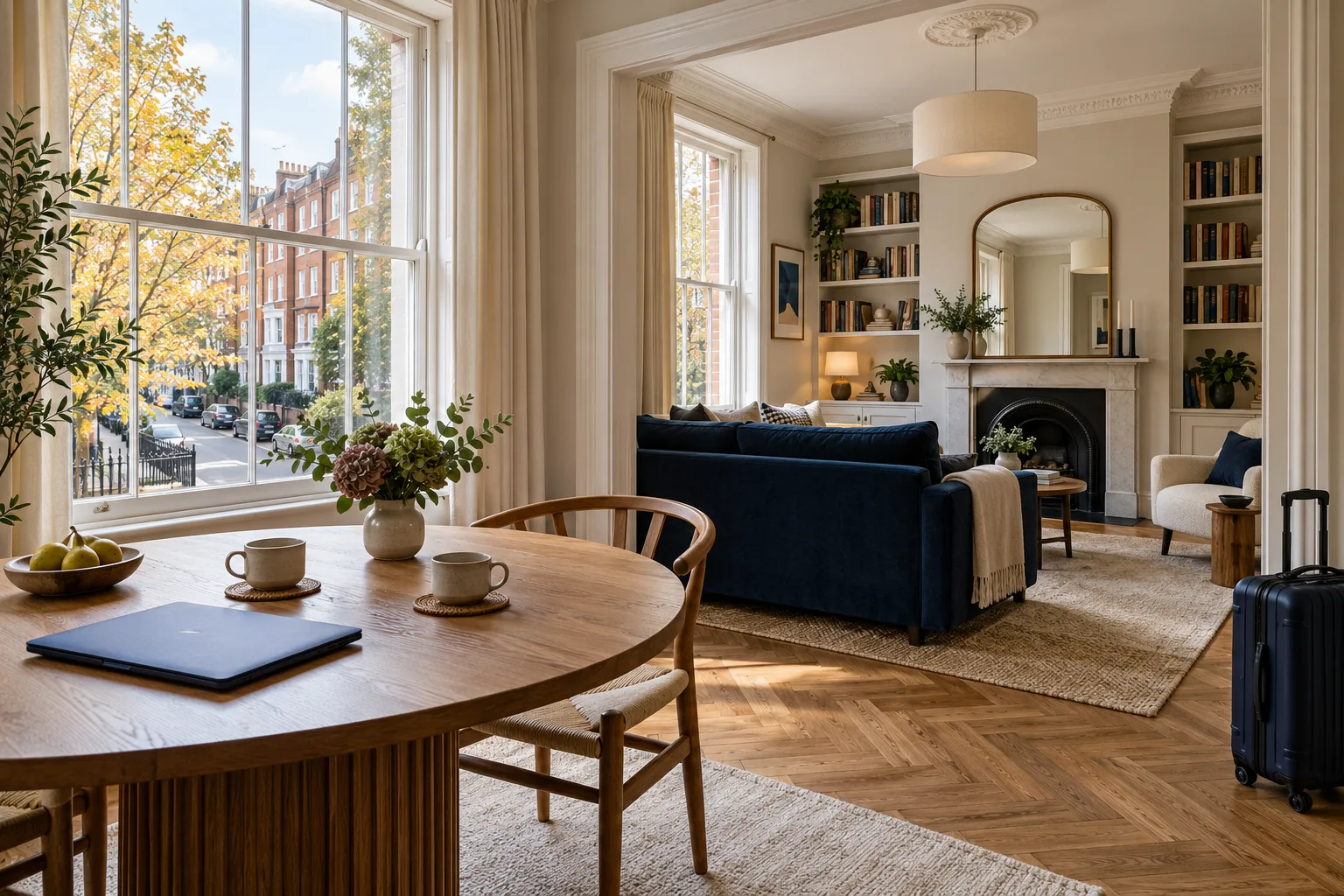
Primary sources checked on 16 October 2026. Guest scenarios and property suggestions are editorial guidance, not measured local demand or individual legal advice. Hero image is an illustrative apartment interior.
Your London property
Find the right fit for your available nights
Explore Airbnb management in London with Lougher & Co. Discuss your location, property features and permissions before choosing a guest strategy.
Explore London management